Bitcoin price is one of the most searched financial terms in the world. Every day, millions of people search for Bitcoin price, Bitcoin price today, BTC value, and Bitcoin price history to understand how the world’s first cryptocurrency is performing.
Bitcoin is not just a digital coin; it is a global financial phenomenon. Since its creation in 2009, Bitcoin’s price has gone from being nearly worthless to reaching tens of thousands of dollars, attracting investors, traders, institutions, and governments.
In this detailed guide, we will explore:
- What Bitcoin price means
- How Bitcoin price works in real time
- Bitcoin price history from 2009 to today
- Factors affecting Bitcoin price
- Bitcoin price volatility
- Bitcoin all-time highs and crashes
- Future outlook of Bitcoin price
This article is designed for beginners, investors, traders, and crypto enthusiasts looking for a complete understanding of Bitcoin price.
What Is Bitcoin Price?
Bitcoin price refers to the current market value of one Bitcoin (BTC), usually displayed in fiat currencies such as:
- USD (US Dollar)
- EUR (Euro)
- GBP (British Pound)
- INR (Indian Rupee)
For example:
If Bitcoin price is $45,000, it means 1 BTC = $45,000 USD
Bitcoin price changes every second because it is traded 24/7 on cryptocurrency exchanges worldwide.
Bitcoin Price in Real Time
How Real-Time Bitcoin Price Works
Bitcoin price is determined by supply and demand on crypto exchanges. When more people want to buy Bitcoin than sell it, the price goes up. When selling pressure increases, the price goes down.
Unlike stock markets:
- Bitcoin trades 24 hours a day
- No weekends or holidays
- Global market with no central authority
Where to Check Live Bitcoin Price
People usually check real-time Bitcoin price on:
- Cryptocurrency exchanges
- Financial news websites
- Crypto price tracking platforms
- Mobile apps and widgets
Real-time price includes:
- Current BTC value
- 24-hour high and low
- Trading volume
- Market capitalization
Bitcoin Price History: From 2009 to Today
Early Years (2009–2012)
- 2009: Bitcoin had no official price. It was traded among developers.
- 2010: First recorded Bitcoin price was around $0.003
- Famous moment: 10,000 BTC used to buy two pizzas
- 2011: Bitcoin reached $1, then surged to $31, and crashed back to $2
At this stage, Bitcoin was mainly used by tech enthusiasts and early adopters.
Growth Phase (2013–2016)
- 2013: Bitcoin crossed $100, later reaching $1,000
- Media attention increased worldwide
- Governments began noticing Bitcoin
- Price volatility was extremely high
- 2014–2015: Market crash due to exchange failures
- Bitcoin price fell below $300
- Many believed Bitcoin was “dead”
However, development and adoption continued quietly.
Mainstream Attention (2017)
- 2017 was a historic year
- Bitcoin price surged from $1,000 to nearly $20,000
- Massive public interest
- Millions of new investors entered the market
This bull run was followed by a major correction.
Bear Market and Recovery (2018–2020)
- 2018: Bitcoin price crashed to around $3,000
- Market fear and negative media coverage
- Many weak projects disappeared
- 2019–2020: Gradual recovery
- Institutional interest began growing
- Bitcoin seen as “digital gold”
Record Highs (2021)
- Bitcoin reached new all-time highs
- Price crossed $60,000
- Adoption by companies and institutions
- Bitcoin ETFs and mainstream acceptance increased
Volatility remained high, but Bitcoin established itself as a major asset class.
Recent Years and Market Cycles (2022–Present)
- Market corrections due to:
- Global economic uncertainty
- Interest rate changes
- Regulatory news
- Bitcoin continues to trade in cycles
- Long-term trend shows growth despite volatility
Bitcoin price remains one of the most watched financial indicators globally.
Factors That Affect Bitcoin Price
1. Supply and Demand
Bitcoin has a fixed supply of 21 million coins. This scarcity is one of the main reasons behind its value.
When demand increases and supply remains limited, price rises.
2. Market Sentiment
News, social media, and public opinion strongly influence Bitcoin price:
- Positive news → price surge
- Negative news → price drop
3. Institutional Adoption
When large companies, funds, or governments adopt Bitcoin:
- Trust increases
- Price often rises
Institutional buying has played a major role in Bitcoin’s price growth.
4. Government Regulations
Regulatory announcements can:
- Boost confidence
- Or create fear and sell-offs
Bitcoin price reacts quickly to regulation-related news.
5. Bitcoin Halving Events
Bitcoin halving occurs approximately every 4 years:
- Mining rewards are reduced by half
- New supply entering the market decreases
Historically, halvings have led to long-term price increases.
Bitcoin Price Volatility
Bitcoin is known for its price volatility.
Why Is Bitcoin So Volatile?
- Still a relatively new asset
- Speculative trading
- Limited liquidity compared to traditional markets
- Strong emotional reactions from investors
Is Volatility Bad?
Not necessarily:
- Traders benefit from price swings
- Long-term investors see volatility as opportunity
- Volatility decreases as adoption grows
Bitcoin All-Time High Price
Bitcoin all-time high (ATH) refers to the highest price BTC has ever reached.
Why ATH matters:
- Shows market confidence
- Attracts media attention
- Encourages new investors
Bitcoin ATH has increased over time, reflecting long-term growth.
Bitcoin Price vs Traditional Assets
Bitcoin vs Gold
- Gold: Physical, stable, traditional
- Bitcoin: Digital, limited supply, portable
Many investors consider Bitcoin digital gold.
Bitcoin vs Stock Market
- Stocks depend on company performance
- Bitcoin depends on network trust and adoption
- Bitcoin is decentralized and global
How Bitcoin Price Is Calculated
Bitcoin price is calculated using:
- Last traded price on exchanges
- Weighted average from multiple platforms
- Volume-based pricing models
Different exchanges may show slightly different prices.
Is Bitcoin Price Predictable?
Bitcoin price prediction is difficult due to:
- Market emotions
- Global events
- Regulatory changes
Analysts use:
- Technical analysis
- Fundamental analysis
- On-chain data
However, no prediction is guaranteed.
Future Outlook of Bitcoin Price
Many experts believe:
- Bitcoin adoption will continue
- Supply scarcity will support long-term value
- Price will remain volatile but trend upward
Bitcoin is increasingly viewed as:
- Store of value
- Hedge against inflation
- Alternative financial system
Why People Search “Bitcoin Price” So Often
- To check investment value
- To decide when to buy or sell
- To track market trends
- To learn about cryptocurrency
Bitcoin price reflects global trust in decentralized money.
Conclusion
Bitcoin price is more than just a number—it represents the value of a revolutionary financial system. From a few cents to tens of thousands of dollars, Bitcoin’s price history tells a story of innovation, risk, adoption, and belief.
Whether you are a beginner learning about crypto or an experienced investor tracking real-time markets, understanding Bitcoin price helps you make informed decisions.
Bitcoin continues to shape the future of digital finance, and its price will remain a key indicator of that transformation.
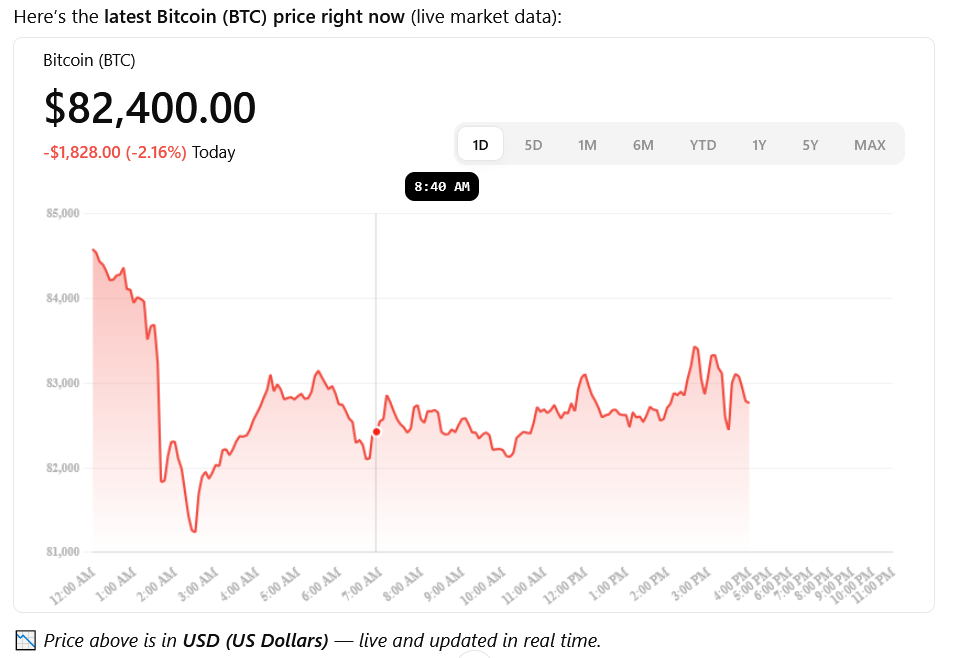
📉 Price above is in USD (US Dollars) — live and updated in real time.
Recent Price Context
- Bitcoin has recently dipped to around $82,000–$88,000 levels, reaching a two-month low amid macroeconomic and market pressures, including investor caution around U.S. Federal Reserve policy.
About The Author